GeoRabble returns to Melbourne on Tuesday 17th September at a new Venue (Coopers Inn – 282 Exhibition St Melbourne). Grab yourself a free ticket and enjoy the night with friends sharing geospatial ideas, free of sales pitches and hidden agendas! Each presentation is light, relevant to geo-something and only 10minutes long.
We are calling for guest speakers – if you have a great geo-spatial idea that you would like to share with a group of like minded people, we want you! Contact the GeoRabble committee asap to express your interesting topic in 20 words or less, or email your idea to melbourne@georabble.org
A very special thanks to our GeoAwesome Spatial Vision Sponsor without whom we couldn’t run this event and provide food to everyone …
Don ‘t forget to put Tuesday the 27th of August into your calendar. GeoRabble Brisbane will be holding its next event at the Pig N Whistle, click the link to check out the fantastic line-up of speakers…
Peter Scarth – Open Source, Open Data, Mapping Beer?
Rob Bischof – Leveraging Your Worth
Stewart Hay – Are your online maps really reaching everyone?
Phil Punter – There’s been an incident at Roma Street
Nathan Woodrow — Contributing to an open source project
Graeme Browning – Story Mapping for Family History
You still have to time to book your tickets and join in the GeoRabble.
The Rabble is back in Sydney with drinks and geo-talks.
We are looking for interesting, entertaining, passionate and downright geogeeky speakers. If you have something you want to share, and can do it in 10 minutes, then please let us know at sydney@georabble.org!
Join us Thursday the 19th of September at the Occidental Hotel. Doors open 5:30 PM for a 6PM start. Registrations will open soon!
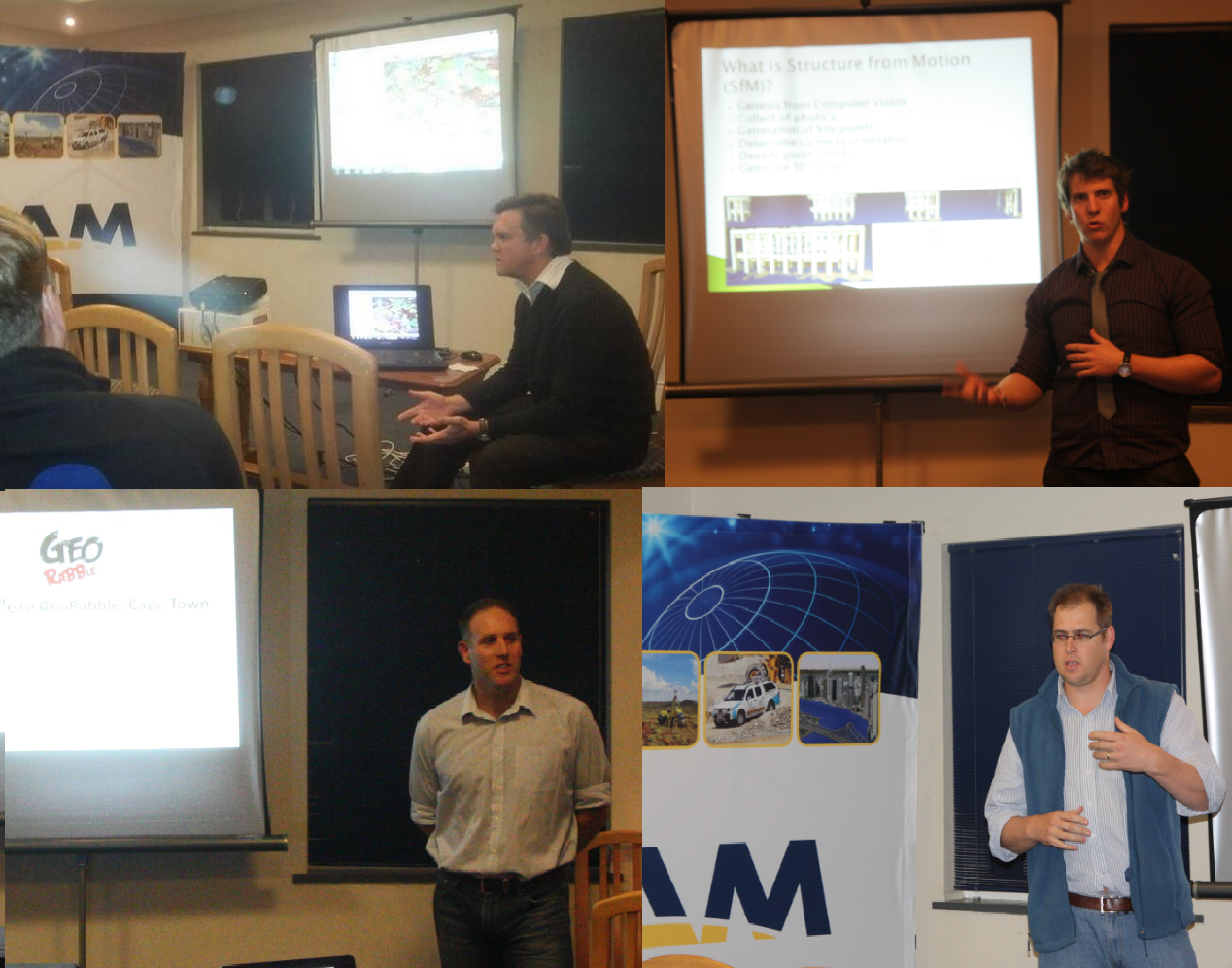
The first Cape Town GeoRabble event, sponsored by AAM Group, took place on Wednesday evening at the Mowbray Golf Club in Cape Town. Approximately 20 people from various industry spheres including government, academia, engineering, geo consulting, software development and internet start-ups attended the night.
The nights presenters in action.
We started at 18h00 with a short welcome and all round introductions, followed by the first presentation delivered by Chris Tanner, titled 3D Modelling. He provided the audience with an amazing bird’s eye view on the level of detail and accuracy that can be achieved in 3D models created by combining aerial photography and LiDAR data. This was followed by another 3D orientated topic titled, Low-cost 3D mapping of an urban environment using Structure from Motion , presented by Sebastien Wenger. Mike Steyn entertained the audience with a summarised view into the past, current and future development in GIS through a presentation topic titled; The Moore’s affect in GIS. This thought provoking presentation highlighted the rapid growth in technology in general and how the geo world is following this trend. The last formal presentation was delivered by Chlodwik Rossouw who asked the question, Is GIS a profession or a tool? He highlighted the different uses of geo tools, technologies & skills across a variety of industry sectors and how industry specific knowledge is affecting our industry. Both Mike and his topics urged people to keep an inclusive and not exclusive mind set and therefore stay aware of what is happening outside of their own geo realm and to keep moving with technological and industry advances.
The night was concluded with quite a few open discussions on how we can build on this first GeoRabble Cape Town event in order for it to appeal to the wider geo community. This successful first night was concluded by more general discussions, networking, food and drink.
Thank you greatly for all who attended, plus AAM Group for sponsoring the event! … until next time.
The inaugural African GeoRabble was hosted by the University of Pretoria and sponsored by AAM Africa. Over 30 GeoRabblers from industries spanning education, government, private and non-profit were treated to geoinspired talks from academic and private industry leaders.
First up was Peter Schmitz who shared on how GIS is being used to solve complex crime mysteries.
Peter was followed by Marius van der Merwe who unpacked “cloud computing in plain English”, how it affects the GIS community in a world that demands information at their fingertips. A truly inspiring look into the future of GIS applications and data storage, dissemination and analysis!
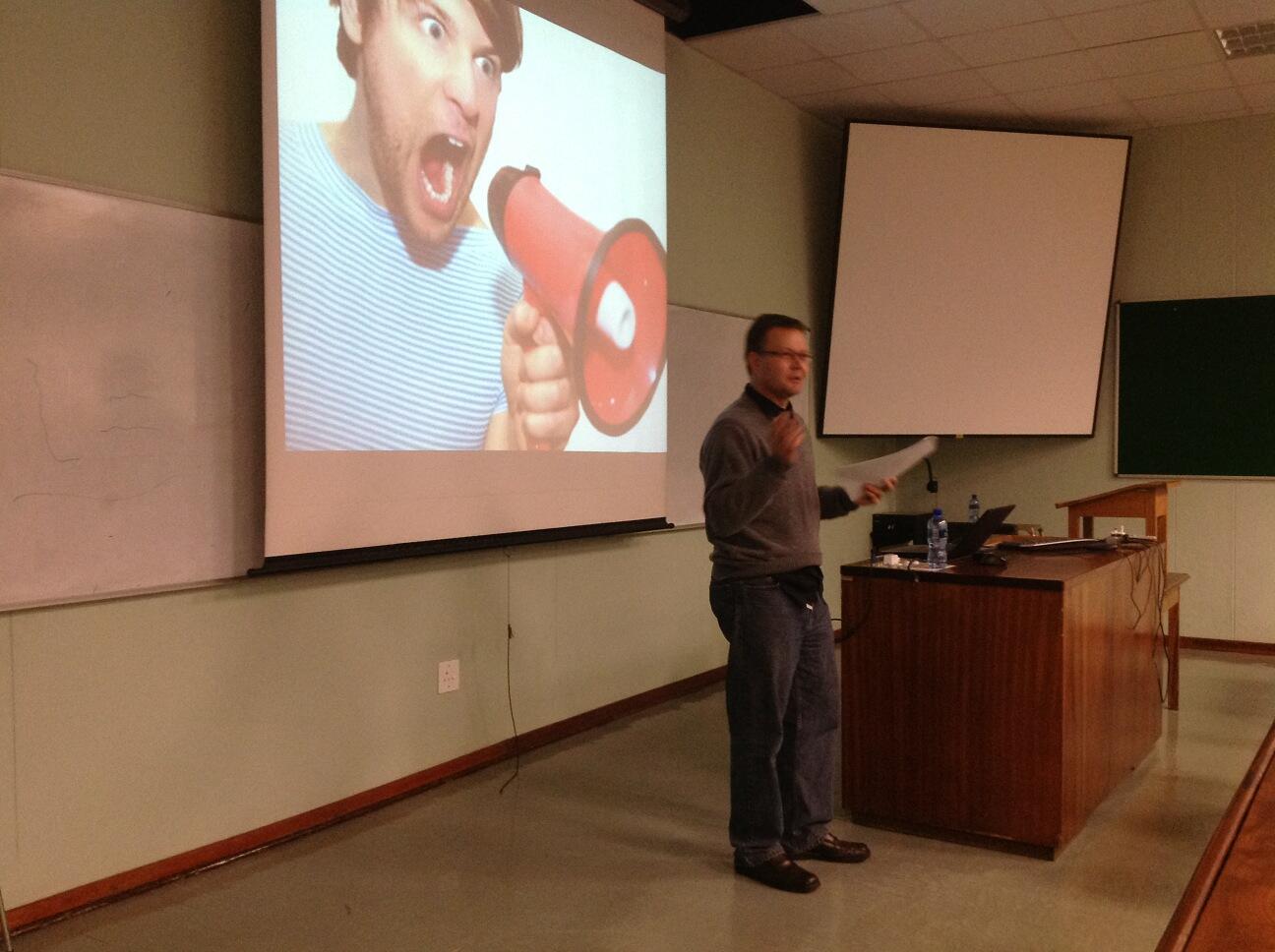
Marius van der Merwe: part of his slide deck, or is the MC telling him time’s up? (photo: Roger Blewett)
From the cloud to the sun, Samy Katumba exposed rabblers to Geoapplications in renewable energy mapping and how solar energy is being used to “em-power” African communities in remote locations.
Stuart Martin took GeoRabblers down a walk on memory lane using imagery. His interactive talk titled “looking beyond the picture” captured moment’s history and how through further thought one can extract more than meets the eye.
Before we knew it, Victoria Rautenbach was in the spotlight shedding insights into spatial cognition and perception. Victoria shed light on how GIS and gaming is demystifying gender stereotypes in spatial perception.
Thanks to the South African GeoRabble team for their commitment in making this first event a huge success. We look forward to many such events throughout South Africa in the years to come. Off to Cape Town we go. To register, visit http://georabble-capetown.eventbrite.com/
With a roll of the dice, the evening kicked off to an exciting start with speaker Kate Raynes-Goldie who brought the world of community game design to the GeoRabble stage. GeoRabblers got a glimpse into how location plays an important role in the construct of community games where play involves people gathering in locations or moving across them. Examples were given of “Gentrification” and Paparazzi; the latter of which was a GPS driven cat-and-mouse game of ambushes, paranoia and scandalous photos; drawing a link with the (perhaps) more familiar ‘game’ of geocaching. A “Community Games” workshop will be held at SpaceCubed in July, for those interested in learning about game design.
Next up on the GeoRabble mic was Erwin Vos, who delighted GeoRabble crowd with pretty pictures and anecdotes of jobs gone-past (including a stint as a sous-chef at the 2010 Vancouver Winter Olympics); with, of course, more onus on the pretty pictures! Passionate about imagery, Erwin describe the multitude of opportunities that exist for interpreting, analysing and using imagery; from detecting houses with poor insulation through to detecting land use change. The possibilities are limited only by the imagination (and knowledge of imagery components and techniques)!
The night’s mystery speaker was then (in dramatic drum rolling excitement) unveiled: Andy Waddington! Well, perhaps not in such dramatic fashion, but you get the idea. An experienced FIG/IHO Cat A Hydrographer (not sure what all those letters mean, but I’m sure they’re awe-inspiring!), Andy spoke about the charting of marine areas and sailed us through the methodologies carried out in the past (“There be dragons” was, once upon a time, a sufficient enough map indicator), those at present and those potentially used in the future. Andy also spoke about how charting now involves less dangerous voyages into areas to be charted (thanks to the power of spatial technologies such as lidar) but that in turn curtailing decisions had to made on aspects such how much area to survey or how much detail to capture. In the context of this, Andy stressed the importance of being able to know when to reuse data and gather as much information as possible from what was available.
Back on dry land, Liz Marjot was the next speaker of the night and spoke about a WA program called Spatial Technology in Schools (STIS). Liz described how the program came into being and the importance of spatial education for youth today. In particular, Liz spoke about how the interaction with spatial technology can spark interest and passion in geography and mapping, which oftentimes is lacking in a traditional classroom setting. Giving examples of some student projects, Liz described how powerful GIS can be in an applied setting in engaging students and encouraged us all to participate in bringing geospatial technology to the youth of today.
Leading on, Shane French spoke to GeoRabblers about the transition of a corporate GIS from a commercial software environment to an open source one; and gave an insightful and honest comparison of the similarities and differences, and the ups and downs encountered along the way (and did a great job of sticking to GeoRabble manifesto by not mentioning any product names!). It was a great overview for those pondering the change and implications it could have.
Last, but not, least GeoRabblers were treated to unique presentation by Hai Tran who spoke about drones and use of them to capture spatial data in a variety of contexts; from constructing aerial panoramic views of landmarks, to monitoring agricultural land, to capturing imagery to assist in the search for a missing Canadian bushwalker. Hai also spoke about the benefits of using drones: the low cost, the ease of deployment and processing; but also the diversity of use – how the drone’s payload can accommodate all sorts of devices for data capture. Though, for those enthusiasts out there, Hai did mention that being able to fly drones of this calibre did require a license (and permission from airport(s) to fly in certain areas).
Many thanks to GeoRabble team for organising the event, to the speakers of the night, to the great MC David Brady and to the event sponsors: AAM.
GeoRabble http://www.georabble.org happens in various locations around Australia, is free and open to anyone, but frequently sells out. If you would like to talk at a future Perth GeoRabble event, please send an email with the title and a short description to perth@georabble.org.
GeoRabble Brisbane #4 is sponsored by Mipela GeoSolutions
CALL FOR SPEAKERS and additional ORGANISERS
GeoRabble Brisbane is holding its next (and fourth) GeoEvent at the Pig N Whistle (Riverside) and it will (as always) take the form of 5-6 x ten minute short and sharp presentations by speakers that could include YOU!
As an all-inclusive assemblage, and with us being at the stage where we are working out the speakers and other logistics, please consider this to be a CALL FOR SPEAKERS and additional ORGANISERS.
However, if you have confidence that whoever speaks will be great (like we do) then you should feel free to book your ticket NOW!
If you’d like to speak at this (or a future) event, let the organisers know what you think the GeoRabble could learn from you! We are keen to receive any and all “abstracts” or draft slides that outline your talk idea so just make contact with your GeoRabble organiser of choice.
If you are someone who would like to help organise please contact your GeoRabble organiser of choice to let that be known too.
The next occurrence of Australia’s favourite casual geo-event, Georabble, will occur on 20 June at the Leederville Hotel in Leederville, Perth.
Speakers so far include:
Kate Raynes-Goldie
Hai Tran
Shane French
Erwin Vos
Liz Marjot
In addition to this line up, the night will feature a mystery speaker, who will remain shrouded in secrecy, wrapped in a riddle, and enclosed in an enigma until a grand revelation on the night. Or something like that.
If you’ve not attended a Georabble before, it’s a fantastic casual night, filled with short, pithy presentations from like-minded geo-types that are free from sales pitches. With 85 tickets snapped up the remaining 65 FREE tickets have 6 days until the event to find owners. Click Here to get your ticket!
We’re pleased that AAMGroup have come on board to sponsor the next Perth Georabble, and expect this event with its pizza, beer and awesome will be just as great as all the others.
The Perth committee have been busy, and the next Rabble will be occurring on Thursday June 20, 2013. If you’d like to be involved in organising, sponsoring or speaking at a future rabble, please contact them via the details on the Perth page. Early tickets are now available at http://georabble-per7.eventbrite.com/
Leaving yesteryear to the yesteryears, this byte of GeoRabble was synced with the worldwide event that was Big Data Week – a “global community and festival of data”. Yes, the puns were international(ly bad)!
Ian McCleod giving us a tour on his yellow submarine
The MC of the night, Nicholas Flett kicked off the sold-out event by introducing us to Ian McCleod, who led us on a colourful subsea tour of the how’s and what’s of data collection from wreckages, artefacts and other curiosities resting on the seabed; including what to do when you encounter a Japanese tank at 38m below surface when you’re only licensed to dive 30m (you go the extra 8m to capture that data!). Emphasised was the importance of keeping pace with ever evolving technology to capture data – and that despite the challenges it might present, data capture is always worth the effort.
Catapulting us from an underwater world to the twittersphere, Nicholas introduced the next speaker, Tim Highfield, who gave us an insight into the how the thoughts and voices of people around world become Big Data through Twitter. Using a combination of open-source and in-house tools and methods, Tim described how Twitter data is captured and some of the analyses that can be done by examining hashtags. GeoRabblers were walked through fascinating examples, including on Australian politics (eg #auspol, #ausvotes), the Queensland Floods, Arab Spring, Eurovision, Tour De France and Occupy Oakland. It would seem that that the very nature of Big Data coming out of Twitter lends itself to a plethora of analytical dimensions, limited only by creativity of the researcher. Tim left the audience with a sobering question of how to determine whether we have too much data or not enough, and a poignant statement – that while media represents the first draft of history, Twitter is the first draft of the present. Tim’s slides and presentation are available online here.
Next up, blasting from the twittersphere to outer reaches of space and time, we were introduced to Kevin Vinsen who gave us a thrilling insight into the Square Kilometre Array (SKA) project. After a short and sweet introduction to space, light-years, the Big Bang and telescopes, GeoRabblers were presented with the enormity of the project data itself: enough raw data to fill 15million 64GB iPods every day! That’s almost 1 exabyte a day! The processing power required is estimated at 100 petaflops per second, about 50 times more powerful than the most powerful computer in 2010 (about equivalent to the processing power of 100 million PCs). If that’s not Big Data, I’m not sure what is! Based on development trends it is expected that a supercomputer with processing power required will exist by 2018. The aim of the radio telescope is to address fundamental questions about the Universe (how did stars and galaxies form after the Big Bang? Is there life beyond Earth?). To help out with processing all this data, Kevin made mention of SkyNet (vaguely ominous name!), an initiative to pool together the processing power of personal computers connected to the internet to mimic the abilities of a supercomputer. What a wonderful opportunity for everyday citizens to contribute to a scientific endeavour of this calibre!
Onwards with the next speaker, Bryan Boruff, who delved into the semantic nature of this new buzz word that is ‘Big Data’, addressing the elephantine question of “What exactly is ‘Big Data’?”. Bryan suggests that Big Data is data that is beyond the conventional or current methods of storing and handling. He went on to describe the dimensions in which Big Data increasingly presents itself – ‘four ‘V’s’: volume, variety, velocity and veracity. So how does one manage this situation? Bryan presented the paradigms of the familiar sequential ‘capture, store, analyse’ method of data handling and that of ‘automated epistemologies’, where data streams are analysed on the fly and not stored. But this presents a troublesome conundrum by contravening a basic scientific principle – that analyses/experiments must be able to be replicated, so therefore the data must be available. Tricky situation – will technology and people keep pace with data? Or will scientific method be challenged?
Wrapping up the presentations of the evening, Paul Farrell introduced GeoRabblers to “Big D”, the cool way to refer to Big Data, and kicked off with the interesting factoid that Big Data is apparently now the number one buzzword since ‘Y2K’, back when everyone thought the world would grind to a halt when the calendar ticked over to 2000. Paul went on to describe that the word ‘data’ is related to the Latin word for ‘fact’, and that it is not necessarily equivalent to information (DIKW Pyramid, anyone?), and that part of the phenomenon that is Big D, is the increasing ‘datafying’ of world – the metrication of more and more aspects of life into data, trying to address the ‘unknown knowns’. Adding to this is the increasing ability of science to not just acquire a sample of data, but the entire ‘population’ of it. Paul goes on to describe that increasingly, Big Data is more about distribution rather than analytical products – and that, in some respect, people’s own minds are the supercomputers. Returning to the seas, Paul left GeoRabblers of the night with an delightful anecdote of life of the sailor Matthew (Fontaine) Maury, “Pathfinder of the Seas” in the 1800s; under whose direction hundreds of ships’ logs were turned into data and locations charted (at least 1.2 million points!) to create Wind and Current Charts, which became an indispensable tool to mariners of all kinds. And that apparently, coincidently, the job title of those people going through the logs to capture the points was….. ‘Computer’.
(most of) The GeoRabble Perth Crew
Many thanks to Darren Mottolini for his time and efforts in organising the event, especially coinciding it with the birth of his 2nd child – Congrats!, to the speakers of the night, to the talented MC Nicholas Flett and to the event sponsor Landgate.
And in the words of Ian McLeod, “keep logging, keep mapping and good luck to you”.
GeoRabble http://www.georabble.org happens in various locations around Australia, is free and open to anyone, but frequently sells out. If you would like to talk at a future Perth GeoRabble event, please send an email with the title and a short description to perth@georabble.org.
The next GeoRabble in Perth is June 20 and free tickets are available here
An open and inclusive forum for GeoGeeks to share, inspire and have fun.









 GeoRabble